







Season notes

Documents with this tag are season summaries such as program listings for a particular concert season.

Waters of the World: A Musical Journey Across Rivers and Seas

Image
Drawing of ocean waves under a partly cloudy sky

Join us for an extraordinary musical voyage that celebrates humanity's timeless connection to water. From the gentle currents of a Czech river to the turbulent storms of the open sea, this program explores the many moods and meanings of the world's waters through the eyes of composers spanning three continents and more than a century.

Our journey begins with the drama of In Storm and Sunshine, where J.C. Heed captures the ever-changing temperament of nature itself. We then confront the darker side of our relationship with the ocean in Antón Alcalde Rodríguez's powerful Marea Negra (Black Tide), a sobering reflection on environmental tragedy.

The rhythmic vitality of Batuque by Oscar Lorenzo Fernández brings us to the coastal traditions of Brazil, followed by Smetana's beloved Die Moldau, which traces the Vltava River's majestic path through the Bohemian countryside. Ralph Vaughan Williams' Sea Songs honors Britain's maritime heritage with rousing naval melodies that have echoed across the waves for generations.

Peter Graham's Harrison's Dream tells the fascinating story of one man's quest to conquer the seas through the invention of the marine chronometer, solving one of history's greatest navigational challenges. The waltz classic Over the Waves (Sobre las Olas), Juventino Rosas's playful tribute to the dancing motion of water, brings us into the final movement of our journey. We close our aquatic voyage with music from Studio Ghibli's beloved animated film Ponyo on the Cliff by the Sea, arranged by our own talented member Thomas Ibbetson. This enchanting tale of a goldfish princess and the ocean's magic brings our program full circle, reminding us of the wonder and imagination that water inspires in us all.

From rivers to oceans, from celebration to caution, from history to heritage, from tragedy to童話—experience the power, beauty, and mystery of water through the universal language of music.

Welcome to our Fall, 2025 season!

Dust off those instruments and replace those squeaky music stands because rehearsals are right around the corner!  ? On August 26th, we will begin the first rehearsal of the fall season.  Robert has put together a fun, challenging, and exciting program.  Be sure to listen to the playlist this week and throughout the season to identify ideas, themes, and challenging parts throughout your section and from section to section. 

ACWE Fall 2025 playlist
 

Another link I would like everyone to review would be the Robert's Rules for a Pleasant ACWE Rehearsal Experience.  These rules help us achieve what we need to in the given time frame before concerts.  Also, section leaders, please advise new members to visit the webpage to view these rules.

Robert's Rules for a Pleasant ACWE Rehearsal Experience
 

⭐Did you know we have ACWE social nights on the last Tuesday of the month? ? Did you know our first rehearsal falls on the last Tuesday of the month?  ? That's right! After our first rehearsal of the season, we will be gathering at The Hideout for an ACWE social night.  Join in to meet fellow band members, geek out about music, and enjoy some tasty drinks!  

The Hideout - 12164 State Hwy 1 Loop, Austin, TX 78758

⭐Want to join the band? New members are always welcome! Check out this page for more information.

Sisyphus, Absurdism, Up the Hill, Ode to Camus

Image
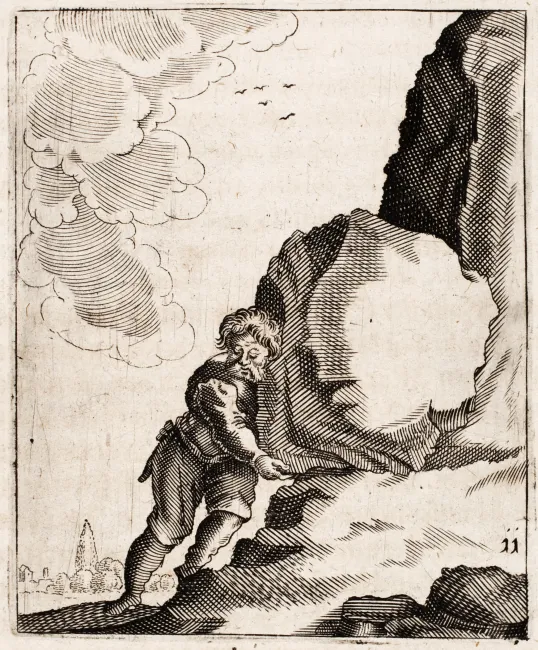
Illustration of Sisyphus pushing a boulder

This fall's season, Sisyphus, Absurdism, Up the Hill, Ode to Camus might be considered truly absurd. Download the Program.

  • Fucik, Entry of the Gladiators
  • R. Strauss, “At the Summit” from Alpensinfonie, arr. Miller
  • Hogan’s Heroes March
  • Prokofiev, Lt Kijé Suite, arr. Laguna
  • Reineke, Fate of the Gods
  • Llinas, La Chancla
  • Alford, Colonel Bogey

Independence Day 2025

Image
Picture of the US flag

Rehearsals for our Independence Day, 2025 Program start on Tuesday, May 20. This year's program includes the following selections:

  • Liberty Fanfare, John Williams
  • The Star Spangled Banner, Key, arr. John Williams
  • Finlandia, Sibelius
  • Washington Post March, Sousa
  • Shenandoah, arr. Frank Ticheli
  • Poet & Peasant Overture, Franz von Suppe, arr. Meyrelles
  • Monkey Business, David Lovrien
  • Battle Hymn of the Republic
  • America the Beautiful, arr. C. Dragon
  • Fantasy on a Theme by Sousa, Boysen
  • Overture 1812, Tchaikovsky
  • Stars and Stripes Forever, Sousa

Celebrating 50 Years of Music!

Image
50 years of ACWE anniversary icon

Celebrating 50 Years of Music! Join the Austin Civic Wind Ensemble (ACWE) for a Golden Anniversary Like No Other!

For half a century, the Austin Civic Wind Ensemble (ACWE) has been filling the heart of Central Texas with the power of music! As Austin’s longest-running community band, we’re marking this milestone with unforgettable performances, special events, and a celebration of the passionate musicians who have kept the music alive since 1975.

Join us as we honor 50 years of free, live concert music, bringing joy to audiences of all ages. Stay tuned for our anniversary concert series, community celebrations, and exclusive behind-the-scenes stories!

Be part of history—follow us, share your ACWE memories, and join the celebration! ??✨

Download and read the program here.

"When in doubt, follow your nose" - Gandalf

Image
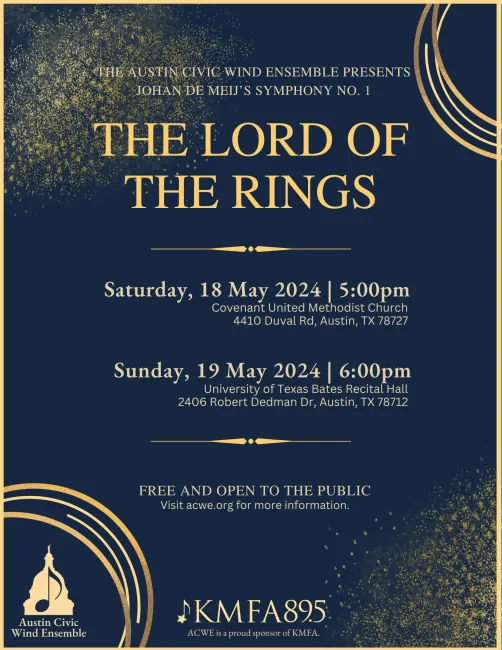
Picture of the Lord of the Rings poster

ACWE's Spring, 2024 concert season

ACWE's Spring, 2004 concert season features John de Meij's, Symphony No. 1 - The Lord of the Rings, and Smetana Fanfare by Karel Husa.

  • Smetana Fanfare - Karel Husa
  • Symphony No. 1 - The Lord of the Rings - Johan de Meij
    1. Gandalf (The Wizard)
    2. Lothlórien (The Elvenwood)
    3. Gollum (Sméagol)
    4. Journey in the Dark: The Mines of Moria, The Bridge of Khazad-Dûm
    5. Hobbits
  • El Capitan- John Philip Sousa

Rehearsals start January 10th, 2023

Tuesday, December 27, 2022, 8pm - Tuesday, January 10, 2023, 7:30pm
4410 Duval Road, Austin Texas 78727

Lenny

ACWE starts rehearsing for the Spring, 2023 concert season on January 10, 2023.

Our spring program, Lenny, features American composers Aaron Copland and Leonard Bernstein. Selections include:

  • Fanfare for the Common Man, Copland
  • Overture to Candide (arr. Grundman)
  • Three Dance Episodes from “On the Town”
  • Symphonic Suite from “On the Waterfront”
  • Slava!
  • Symphonic Dances from West Side Story
  • Make our Garden Grow

We always welcome prospective members, and are in need of percussionists and double reed players. Learn more about joining at Join the band!

Independence Day, 2018 concert season

Image
Picture of the US flag

Join us for special musical events for the July 4th celebrations of America's Independence day. Selections include

  • The Star Spangled Banner, arranged by John Philip Sousa
  • Pineapple Poll, Arthur Sullivan, arranged by Charles Mackerras
  • America the Beautiful, Samuel Augustus Ward, arr. Carmen Dragon
  • Overture "1812", P. Tschaikowsky, arr. Mayhew L. Lake
  • The Black Horse Troop, John Philip Sousa
  • His Honor, Henry Fillmore
  • Brooke's Chicago Marine Band March, Roland F. Seitz
  • The Official West Point March, Philip Egner
  • Trooper Salute, arr. Jay Bocock
  • The Girl I Left Behind, arr. Leroy Anderson
  • Rolling Thunder, Henry Fillmore
  • Bravura, C. E. Duble
  • Joyce's 71st N.Y. Regimental March, Thomas Barnes Boyer
  • The Stars and Stripes Forever, John Philip Sousa

Our Independence Day concerts include:

  • Sunday, July 1st at 2:00PM at Unity Church of the Hills
  • Thursday, July 4th at 9:00AM at Towne Square, Steiner Ranch

le mystère de la mort

Image
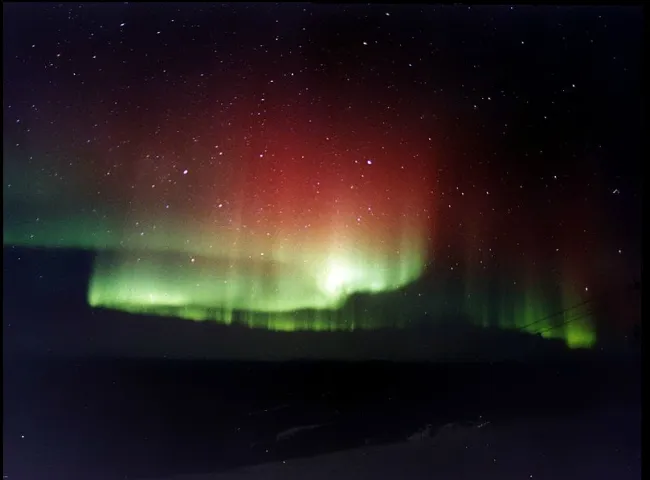
A picture of the Northern Lights

Our Fall, 2015 concerts will feature two works by Austin-based composers. Aurora Borealis is a colorful work by Joel Love, who recently completed his doctoral work at UT. Anthems by ACWE's own Michael Bell commemorates the fall of the Berlin Wall. The program will also feature the spooky Dance Macabre by Saint-Saens and excerpts from the powerful Requiem by Verdi.

We will be playing two concerts.

  • Friday, October 30th, 7:30PM at Covenent United Methodist Church
  • November 8th, 5PM at Episcopal Church of the Resurrection.

Mike Bell - Anthems

Anthems derives its title from the use of the national anthems of Slovakia, The Czech Republic and Hungary as source material. The original version of the piece for 10 winds and 2 percussionists was written in 1990. News broadcasts at the time were occupied with the fall of the Berlin Wall. Anthems is a reflection of those events. One news story in particular focused on how the countries such as Czechoslovakia, Hungary, Yugoslavia and others would be affected by the fall of the Berlin Wall. The anthems of those countries were played and I was struck by their beauty.

The first movement, Oppression, begins with a heaviness representing the Soviet authority and rapid chromatic figures representing the unrest and frustration of the people. The Slovak anthem makes its first appearance in a hodge-podge orchestration as if the people are trying to make due with what they have. A section influenced by Shostakovich follows. The Slovak anthem becomes more fragmented and then at the end of the movement is stomped out by the oppressive forces.

The second movement is a reverie based on the Czech national anthem. It is sparsely scored and dream like in quality. it is meant to be a stark contrast from the first movement, a diversion, a sense of hope, but still colored by reality.

The third movement begins with tension, then the percussion symbolically tear down the wall. The section that follows is a jubilant celebration. Next the woodwinds intone the Hungarian national anthem, which is followed by a fast rhythmic dance in 6/8. The brass then get their turn with the Hungarian anthem which gives way to a finale featuring a return of the celebratory material.

Joel Love - Aurora Borealis

Aurora Borealis was inspired by the natural phenomenon that occurs in the northern latitudes. In short, auroral events are caused by the collision of energetic, charged particles with atoms in the high altitude atmosphere. The composer spent most of a summer playing piano in a rock band aboard a cruise ship that traveled from Seattle, WA to Anchorage, AK and back several times. During a geomagnetic event late one night, he was fortunate enough to see the Aurora in the distance while sailing from Juneau to Hoonah, AK. The piece has three main figures: an ascending/descending tetrachord, a repeated eighth-note motive, and a melody (first heard in the clarinet).

In May of 2013, Aurora Borealis was selected as a finalist in the 3rd International Franck Ticheli Composition Contest.

Verdi - Manzoni Requiem

The Messa da Requiem is a musical setting of the Roman Catholic funeral mass (Requiem) for four soloists, double choir and orchestra by Giuseppe Verdi. It was composed in memory of Alessandro Manzoni, an Italian poet and novelist whom Verdi admired. The first performance, at the San Marco church in Milan on 22 May 1874, marked the first anniversary of Manzoni's death. The work was at one time called the Manzoni Requiem. Although originally composed for liturgical purposes, in modern days it is rarely performed in liturgy, but rather in concert form of around 85–90 minutes in length. Musicologist David Rosen calls it 'probably the most frequently performed major choral work composed since the compilation of Mozart's Requiem.'

Yarborough – Parody

Kind of marchy, kind of not. Only about 2 minutes.

Starts like a march. of clowns. Mimes. Who have been drinking too much. They stumble into a dark alley. But quickly turn around. into the street. with cars whizzing by. Cars fly by, faster and faster. Until... they stop traffic with a crash! They proceed across the street into a somber park. They listen to the birds. Where they all fall down and look at the sky, laughing a sigh of relief.

Stephen Yarbrough began his musical career as a flutist with the Air Force Academy Band outside of Colorado Springs, Colorado. After four years of service he returned to his Alma Mater, The University of Oklahoma, and took up the study of composition with Michael Hennagin, a student of Aaron Copland. Yarbrough has been awarded numerous grants, including an Emerging Artist Fellowship, and Artists Career Development Grant, and Artists Project Grant (three times), and an Artists Fellowship Grant (2010), all from the South Dakota Arts Council.

Saint-Saëns - Danse Macabre

Danse macabre, Op. 40, is a tone poem for orchestra, written in 1874 by the French composer Camille Saint-Saëns. It started out in 1872 as an art song for voice and piano with a French text by the poet Henri Cazalis, which is based on an old French superstition. In 1874, the composer expanded and reworked the piece into a tone poem, replacing the vocal line with a solo violin.
According to legend, "Death" appears at midnight every year on Halloween. Death calls forth the dead from their graves to dance for him while he plays his fiddle (here represented by a solo violin). His skeletons dance for him until the rooster crows at dawn, when they must return to their graves until the next year.