Concert liner notes

Tag nodes that contain descriptions of the pieces the band performs.

le mystère de la mort

Image
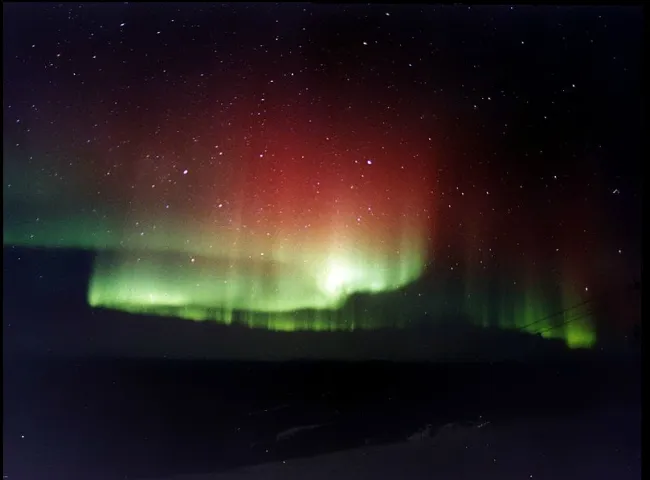
A picture of the Northern Lights

Our Fall, 2015 concerts will feature two works by Austin-based composers. Aurora Borealis is a colorful work by Joel Love, who recently completed his doctoral work at UT. Anthems by ACWE's own Michael Bell commemorates the fall of the Berlin Wall. The program will also feature the spooky Dance Macabre by Saint-Saens and excerpts from the powerful Requiem by Verdi.

We will be playing two concerts.

  • Friday, October 30th, 7:30PM at Covenent United Methodist Church
  • November 8th, 5PM at Episcopal Church of the Resurrection.

Mike Bell - Anthems

Anthems derives its title from the use of the national anthems of Slovakia, The Czech Republic and Hungary as source material. The original version of the piece for 10 winds and 2 percussionists was written in 1990. News broadcasts at the time were occupied with the fall of the Berlin Wall. Anthems is a reflection of those events. One news story in particular focused on how the countries such as Czechoslovakia, Hungary, Yugoslavia and others would be affected by the fall of the Berlin Wall. The anthems of those countries were played and I was struck by their beauty.

The first movement, Oppression, begins with a heaviness representing the Soviet authority and rapid chromatic figures representing the unrest and frustration of the people. The Slovak anthem makes its first appearance in a hodge-podge orchestration as if the people are trying to make due with what they have. A section influenced by Shostakovich follows. The Slovak anthem becomes more fragmented and then at the end of the movement is stomped out by the oppressive forces.

The second movement is a reverie based on the Czech national anthem. It is sparsely scored and dream like in quality. it is meant to be a stark contrast from the first movement, a diversion, a sense of hope, but still colored by reality.

The third movement begins with tension, then the percussion symbolically tear down the wall. The section that follows is a jubilant celebration. Next the woodwinds intone the Hungarian national anthem, which is followed by a fast rhythmic dance in 6/8. The brass then get their turn with the Hungarian anthem which gives way to a finale featuring a return of the celebratory material.

Joel Love - Aurora Borealis

Aurora Borealis was inspired by the natural phenomenon that occurs in the northern latitudes. In short, auroral events are caused by the collision of energetic, charged particles with atoms in the high altitude atmosphere. The composer spent most of a summer playing piano in a rock band aboard a cruise ship that traveled from Seattle, WA to Anchorage, AK and back several times. During a geomagnetic event late one night, he was fortunate enough to see the Aurora in the distance while sailing from Juneau to Hoonah, AK. The piece has three main figures: an ascending/descending tetrachord, a repeated eighth-note motive, and a melody (first heard in the clarinet).

In May of 2013, Aurora Borealis was selected as a finalist in the 3rd International Franck Ticheli Composition Contest.

Verdi - Manzoni Requiem

The Messa da Requiem is a musical setting of the Roman Catholic funeral mass (Requiem) for four soloists, double choir and orchestra by Giuseppe Verdi. It was composed in memory of Alessandro Manzoni, an Italian poet and novelist whom Verdi admired. The first performance, at the San Marco church in Milan on 22 May 1874, marked the first anniversary of Manzoni's death. The work was at one time called the Manzoni Requiem. Although originally composed for liturgical purposes, in modern days it is rarely performed in liturgy, but rather in concert form of around 85–90 minutes in length. Musicologist David Rosen calls it 'probably the most frequently performed major choral work composed since the compilation of Mozart's Requiem.'

Yarborough – Parody

Kind of marchy, kind of not. Only about 2 minutes.

Starts like a march. of clowns. Mimes. Who have been drinking too much. They stumble into a dark alley. But quickly turn around. into the street. with cars whizzing by. Cars fly by, faster and faster. Until... they stop traffic with a crash! They proceed across the street into a somber park. They listen to the birds. Where they all fall down and look at the sky, laughing a sigh of relief.

Stephen Yarbrough began his musical career as a flutist with the Air Force Academy Band outside of Colorado Springs, Colorado. After four years of service he returned to his Alma Mater, The University of Oklahoma, and took up the study of composition with Michael Hennagin, a student of Aaron Copland. Yarbrough has been awarded numerous grants, including an Emerging Artist Fellowship, and Artists Career Development Grant, and Artists Project Grant (three times), and an Artists Fellowship Grant (2010), all from the South Dakota Arts Council.

Saint-Saëns - Danse Macabre

Danse macabre, Op. 40, is a tone poem for orchestra, written in 1874 by the French composer Camille Saint-Saëns. It started out in 1872 as an art song for voice and piano with a French text by the poet Henri Cazalis, which is based on an old French superstition. In 1874, the composer expanded and reworked the piece into a tone poem, replacing the vocal line with a solo violin.
According to legend, "Death" appears at midnight every year on Halloween. Death calls forth the dead from their graves to dance for him while he plays his fiddle (here represented by a solo violin). His skeletons dance for him until the rooster crows at dawn, when they must return to their graves until the next year.

Fiftieth Anniversary Celebration

Image
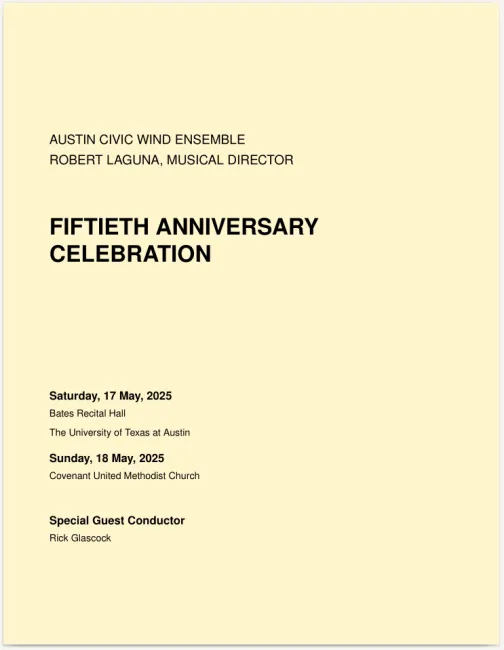
Picture of the cover of the program for the Spring 2025 concert

DOWNLOAD THE PDF


AUSTIN CIVIC WIND ENSEMBLE

ROBERT LAGUNA, MUSICAL DIRECTOR


FIFTIETH ANNIVERSARY CELEBRATION


Saturday, 17 May, 2025

Bates Recital Hall

The University of Texas at Austin

Sunday, 18 May, 2025

Covenant United Methodist Church

Special Guest Conductor

Rick Glascock

AUSTIN CIVIC WIND ENSEMBLE

ACWE’s first concert was performed by a small but plucky group with uneven instrumentation.

Flourish for Wind Band - R. Vaughn Williams

Flourish for Wind Band is a short overture composed by Ralph Vaughan Williams for a 1939 pageant at the Royal Albert Hall. Originally scored for military band, the piece was lost for decades before being rediscovered in 1971. Notable for its accessibility, Flourish for Wind Band followed Vaughan Williams’ great masterworks for band, English Folk Song Suite and Toccata Marziale. The piece holds significance in early 20th-century concert band literature.

Muskrat Ramble -  E.Ory, arr. Walter Beeler

Muskrat Ramble is a seminal jazz composition by trombonist Edward “Kid” Ory, first recorded by Louis Armstrong and His Hot Five in Chicago in 1926. It quickly became a staple of the New Orleans jazz repertoire, and later became a jazz standard.

Despite its popularity, Ory initially received no royalties for Muskrat Ramble. In 1965, Country Joe McDonald adapted the tune for his anti-Vietnam War protest song I-Feel-Like-I’m-Fixin’-to-Die Rag, which gained significant attention after being featured at Woodstock. Ory’s daughter, Babette Ory, filed a copyright infringement lawsuit in 2001, alleging that McDonald had used portions of Muskrat Ramble without permission. The case was dismissed due to the statute of limitations, but it highlighted the ongoing relevance of Ory’s composition.

Walter Beeler (1908-1973) was one of the leading brass band educators, arrangers, and conductors in the United States.

The Kadiddlehopper March - Red Skelton, arr. Ron Roullier

The Kadiddlehopper March is a distinctive short selection composed by Red Skelton. Skelton performed for eight U.S. presidents and three Roman Catholic Popes, composed more than 8,000 songs, 64 symphonies, wrote books, and his paintings and drawings remain art collectors' treasures.

In 1969, The Kadiddlehopper March was performed by the Boston Pops Orchestra under the direction of Arthur Fiedler. The march is inspired by Skelton's iconic character, Clem Kadiddlehopper, a bumbling yet endearing country bumpkin.

March Lamar - Clifton Williams

James Clifton Williams (1923-1976) was a composer who began his academic career as Professor of Composition at the University of Texas. Williams also served as a hornist and guest conductor with the symphonies in San Antonio, New Orleans, and Austin.

March Lamar was written in 1964 for the band at Lamar Middle School in Austin, where Williams’ children were students.

Liturgical Music for Band, Op. 33 - Martin Mailman

Composed in 1963 and commissioned by the Greenville County High School Band in Virginia, Liturgical Music for Band is a work in four movements inspired by sections of the Catholic Mass. It has become a landmark in the band repertoire, widely performed and appreciated by generations of students. Each movement reflects a different part of the Mass:

  1. Introit, a joyful processional with bell-like sounds symbolizing the entrance into worship.
  2. Kyrie, a somber, prayerful movement based on the phrase “Lord have mercy,” with rhythms reflecting the natural inflection of the word “Kyrie.”
  3. Gloria, bright and celebratory, mirroring the exclamation “Glory to God in the highest.”
  4. Alleluia, a vigorous fugue with uplifting brass and woodwind interplay, representing spiritual exaltation and heavenly aspirations.

Mailman's work seeks to musically capture the emotional and spiritual experience of a worship service.

1776, “The Lees of Old Virginia” - Sherman Edwards

1776 is a musical based on the events surrounding the signing of the Declaration of Independence. It premiered on Broadway in 1969, and won three Tony Awards, including Best Musical. Austin Parks and Recreation performed the musical at the Zilker Hillside Theater in the summer of 1975, with ACWE founder Bill Whitworth in the orchestra.

ACWE performed this piece in 1975, leading up to the Bicentennial celebrations of the adoption of the Declaration of Independence.

Instant Concert - Harold L. Walters

Instant Concert by Harold L. Walters has become a staple in band literature. Composed in 1965, this novelty medley features 30 well-known melodies from various genres, including classical themes, folk songs, and popular tunes. Walters cleverly and seamlessly weaves these diverse melodies into a continuous performance lasting just over three minutes.

Instant Concert was ACWE's most-performed non-Christmas piece in the early decades. Over the years ACWE even performed Instant Concert as an encore.

The Grand Marshal - Red Skelton

The Grand Marshal march, composed by Red Skelton, is a ceremonial piece dedicated to the Honorable Everett McKinley Dirksen, the U.S. Senator from Illinois. Senator Dirksen played a pivotal role in the passage of the Civil Rights Act of 1964. Skelton, a longtime admirer of Dirksen's eloquence and leadership, composed this march as a tribute to honor his contributions to American politics.

The march was introduced on “The Red Skelton Hour” on January 16, 1968.

When Do You Say Budweiser? - Steve Karmen

When You Say Budweiser, You’ve Said It All is a memorable advertising jingle composed by Steve Karmen in 1970 for Anheuser-Busch’s Budweiser beer. The phrase "When You Say Budweiser, You’ve Said It All" became synonymous with the brand, reinforcing its position as "The King of Beers."

The Budweiser song played at ACWE's first concert was arranged by UT graduate and Texas band director Steve Curl. It is the only piece that was never played by ACWE again, until now.

The Klaxon - Henry Fillmore

Composed in 1929 for the Cincinnati Automobile Show, The Klaxon by Henry Fillmore is a lively concert march celebrating the iconic Klaxon automobile horns of the early 20th century. At its 1930 premiere, Fillmore debuted the "Klaxophone", a novelty instrument made from twelve car horns powered by a car battery, to replicate the distinctive Klaxon sound.

Castle Gap - Clifton Williams

Castle Gap by Clifton Williams is a concert march composed in 1964, commissioned by the Rankin High School Band in Rankin, Texas. The piece is named after Castle Gap, a historic pass through the Castle Mountains in western Upton County, Texas. This gap has a rich history, having been used by nomadic tribes, Spanish explorers, and pioneers as a crucial crossroad.

Castle Gap Concert March captures the rugged and adventurous spirit of the West Texas landscape.

Tara’s Theme - Max Steiner, arr. Ross Hastings

"Tara's Theme" from Gone with the Wind is a poignant and iconic melody composed by Max Steiner, serving as a musical leitmotif for the O'Hara family's plantation, Tara. This theme is characterized by its sweeping, romantic lines and has become emblematic of the film's grandeur and emotional depth. Arranged for concert band by Ross Hastings, this version of "Tara's Theme" captures the essence of the original composition while adapting it for wind ensemble performance.

Elsa’s Procession to the Cathedral - Richard Wagner

Rick Glascock, guest conductor; Scout Goldsmith, harp

"Elsa's Procession to the Cathedral" is one of the most revered excerpts from Richard Wagner’s 1850 opera Lohengrin, showcasing his mastery of orchestration and emotional drama. In the opera, this music accompanies the solemn and regal moment as Elsa is led to the cathedral for her wedding—a scene filled with both triumph and underlying foreboding.

Lucien Cailliet’s transcription of "Elsa’s Procession to the Cathedral" for concert band is one of the most celebrated symphonic transcriptions in the wind band repertoire. Cailliet, a French-American composer and arranger known for his skill in adapting orchestral music for winds, treated Wagner’s work with great respect and artistic sensitivity.

Disco Inferno - Leroy Green and Ron Kersey, arr. John Higgins

This arrangement of The Trammps' 1976 disco classic, Disco Inferno, originally featured in the Saturday Night Fever soundtrack, captures the song's infectious energy and rhythmic drive.

THE AUSTIN CIVIC WIND ENSEMBLE

The Austin Civic Wind Ensemble is a gathering of adult musicians enjoying the challenge of a high-quality repertoire. The wide range of age and skill level supports our value of inclusion and fosters our mission of using music for lifelong learning, while promoting joy in our community through live performances.

Created in 1975, the Austin Civic Wind Ensemble (ACWE) is a community ensemble formed of both amateur and professional musicians. It is the oldest civic band in Austin. We are a group of volunteer musicians committed to providing musical experiences for our community. You can join at any time. No auditions are required.

ROBERT LAGUNA, MUSICAL DIRECTOR

Robert Laguna is an accomplished performer, arranger, conductor, and practitioner weaving elements of the body-mind-spirit connection into his music and life. Laguna was born in Rio Piedras, Puerto Rico and completed his bachelor's at Southwest Texas State University where he studied music education and went on to teach band in the Texas public school systems for 8 years. He then completed his master's at the Academy of Oriental Medicine at Austin where he studied Asian medicine thereafter going into private practice as an acupuncturist. In 1999, he became the dean of students at his alma mater, AOMA.

Laguna joined the Austin Civic Wind Ensemble in 1998. Later that year, he became the semi-conductor for the group, assisting Rick Glascock from 1997-2003 and Paul Crockett from 2003-2005. In 2005, he was selected as Conductor of the Austin Civic Wind Ensemble. While a member of ACWE, he joined other civic music groups including the Austin Philharmonic Orchestra and Cori Spezzatti. He also joined and formed performing ensembles like the Frontier Brass, Austin Brass Band, and the Brandished Brass.

RICK GLASCOCK, GUEST CONDUCTOR

Originally from San Francisco, Rick Glascock received his Masters in Music in percussion performance from SUNY Stony Brook. After five years as Principal Percussionist with the Filarmónica de Jalisco in Guadalajara, Mexico, he and his family moved to Austin where he worked as a band director in Pflugerville and Austin as well as being an active jazz vibraphonist. From 1997 to 2003 he proudly directed the Austin Civic Wind Ensemble with the assistance of Robert Laguna.

In 2008 Rick and his family moved to Asia with the opportunity to run the middle school band and jazz program at the Shanghai American School. In 2015 he conducted the Association for Music in International School’s Middle School Honor Band in Chennai, India. Now back in Austin, he enjoys playing drums and singing with several groups around town.

PERFORMERS

Flute

  • Caroline Acuña
  • Sherry Aten
  • Kathleen Brotherton
  • William Delgado
  • Shawn Dennison
  • Melissa Dowdy
  • Tina Renee D'Souza
  • Aldo Esparza
  • Mary Gasal
  • Kathie Goldsmith
  • Ashley Hilton
  • Karina Jakobeit
  • Joanna Lucero
  • Susan McClure
  • Alyssa McKnight
  • Kara Myers
  • Liz Payne
  • Caitlyn Schroeder-Willuhn
  • Jack Si
  • Debbie Spurlock
  • Andrea Torres

Oboe

  • Robin DeWeese
  • Nina Siegel

Eb Clarinet

  • Karen Delk

Clarinet

  • Jay Berry
  • Luis Castillo
  • Kevone Hospedales
  • Jessica Johnson
  • Caitlin Keegan
  • Danny Kostelancik
  • Sara Ramasastry
  • Janet Rice
  • Alicia Rusthoven
  • Taylor Queitsch
  • Caroline Soper
  • Meagan Weaver

Alto Clarinet

  • Ellen Knapton

Bass Clarinet

  • Michael Bonagurio
  • Aaron Cano
  • Laura Larsen

Bassoon

  • Melanie Wedige

Alto Saxophone

  • Kristin Blake
  • Allison Cavazos
  • Debbie Dalke
  • Mariana Gama
  • Mariel Garcia
  • Michelle Lobermeier
  • Sharon Melville
  • Chris O'Connor
  • Stephanie Pektas
  • Laura Scholten
  • Eric White

Tenor Saxophone

  • Shayne Calhoun
  • Chyna Christensen
  • Thomas Ibbetson

Baritone Saxophone

  • Rollie Cole
  • Kayla Grissett

Trumpet

  • Jennifer Clarke
  • Jake Clement
  • David Dalke
  • Marcy Graham
  • James Hatheway
  • Amber Nepodal
  • Julio Sanchez
  • Kevin Slaughter
  • Duke Tanner
  • Hannah Wilson
  • Rob Wilson

Horn

  • Clint Colisch
  • Kalyn Cordova
  • Tyler Darsey
  • Marc Frazier
  • Melissa Kunkel
  • Nancy Middlebrook
  • Chris Willuhn

Trombone

  • Rene Barron
  • Warren Gill
  • Chris Glenn
  • Giuseppe Maccagnan
  • Rob Muñoz
  • Bob Roeder

Euphonium

  • James Barnard
  • Seth Butler
  • Jack Robertson
  • Danny Tosiano

Tuba

  • Michael Bell
  • Rick Colvin
  • David Dawson
  • Frank Salinas

Percussion

  • Josh Barber
  • Stephen Jones
  • Terra Lindgren
  • Alyssa McKnight
  • Seth Neuman
  • Ronald Reed
  • Bob Russin

Harp

  • Scout Goldsmith

THANK YOU FOR YOUR SUPPORT

ACWE is an 501(c)3 non‑profit corporation. Our corporate underwriters and individual sponsors play an important role in our ability to bring free public performances of great concert band literature to the Austin area. Visit acwe.org/sponsor to learn more.

We are proud to recognize Central Market and Westbank String Shop for their support during our 50th anniversary season.

ACWE would like to thank Clif Maloney for his generous donation to the Austin Civic Wind Ensemble in memory of his beloved wife, Karen Maloney.

“The band rehearsed on the second floor of the old, unairconditioned building that housed the Blanco Street Firehouse. Members usually left the large windows open, which annoyed some neighbors.

 

Concert Notes - Spring 2018

Image
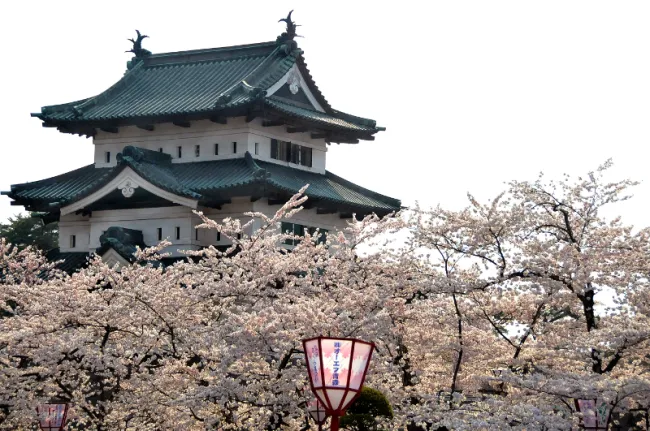
Cherry blossoms around a Japanese temple

Our Spring 2018 concert series has an Asian theme. Download the flyer for our concerts.

Rising Dragons

Robert W. Smith

A tremendous work of epic proportion that honors the memory of a great Korean naval hero.  Smith paints a vivid portrait of this commanding figure and the historic events of his lifetime, culminating in a great naval battle.  Complete with the mechanized sounds of the ironclad turtle ships, Rising Dragons captures all the elements of a tremendous conflict at sea.

Prayer for Asia

Anthony LaBounty

Prayer For Asia is an original work for wind orchestra whose main theme is inspired by prayer. Simple and pure in its core, the powerful harmonic and textural scoring make this work both music for the musician and inspiration for a new generation of audiences. The imagery of this musical entreaty tranquilly unfolds with a clarinet exposition that authentically captures the essence of an invocation. It is then adeptly passed to the English horn and masterfully developed via sectional highlighting, superlative percussion, and a climax of elysian dimension. Prayer For Asia conveys a reverence and reflection that will touch mature ensembles and audiences in a significant manner.

Variations on a Korean Folk Song

John Barnes Chance

Composer John Barnes Chance first heard Arirang, a popular Korean lyrical folk song, when he was stationed in Korea in the 1950s while serving in the US Army. Arirang is estimated to be at least 600 years old and is considered by many to be the unofficial national anthem of Korea. Arirang serves as the basis for Chance’s widely-known work Variations on a Korean Folk Song, with its distinctly beautiful melody first presented to the listener with the deep, sonorous tones of the clarinet.

Suite from China West

Chen Yi
  • II. Meng Songs
  • IV. Miao Dances

The authentic folk music from China West has amazed and inspired the composer to write this piece, which has elements drawn from the folk songs Gadameilin and Pastoral of the Meng People, Ashima of the Yi People, Du Mu and Amaliehuo of the Zang People, and Dou Duo and the Lusheng ensemble music of the Miao People.

Nessun Dorma

Guest soloist, Jameson James, Tenor
Giacomo Puccini, arr. Mark Williams

From the third act of Puccini’s renowned opera Turandot, Nessun Dorma is one of the most memorable tenor arias of all time. It is sung by the Prince Calaf, who falls in love with the beautiful but cold Princess Turandot. She has declared that any man who wishes to wed her must first answer three riddles. If he fails, he will be beheaded. In the aria, Calaf expresses his triumphant assurance that he will win the princess. A stunning performance by guest vocalist Jameson James accompanies Mark Williams’ arrangement of this masterpiece for concert band.

Intermission

Come, Drink One More Cup

Qian Chen

A remarkable and unique selection by one of China's best-known wind ensemble composers, Come, Drink One More Cup is inspired by Wang-Wei’s classical poem by about the pain of parting from a friend as he leaves to join the army in a distant town.

The morning rain at Weicheng dampens the light dust,
All the houses and willows look fresh after the rain.
Come, drink one more cup of wine before you leave
After you go west to Yangguan, there will be no more friends.

In a Japanese Garden

Ed Huckeby

Written as a result of the composer's visit to Japan, In a Japanese Garden is constructed in the style of a promenade, allowing the listener to stroll through a traditional garden filled with sculptured trees and shrubs, fish ponds, and beautiful flowers. The subtle melodic and harmonic elements convey a carefree sense of serenity, joy, and peace to the audience.

Fantasy on a Japanese Folk Song

Samuel Hazo

Based on the hauntingly beautiful Sunayama, a tapestry of sounds and emotions are woven together to represent this dramatic story in musical terms. Fantasy on a Japanese Folk Song tells a story of the inner conflict of a Japanese woman who falls in love with an American man. She is torn between a life with him afar and her longing for the culture of her childhood. From time to time, she plays a music box given to her by her parents (represented by the Sunayama theme), which brings forth a flood of homeland memories.

Dragon Boat Festival

Michael Boo

The excitement of Chinese dragon boat races is captured in this colorful and bombastic work. During the dragon boat races, rowers on long, thin boats race to the beat of a large drum, and fireworks are set off at random from tall poles on the boats. The pentatonic melody creates a recognizably Asian sound, while the percussion section provides the sound of the fireworks.

Possible encore

Sensei's Ride on the Cherry Blossom Express

Robert W. Smith

Sit back, relax, and enjoy the scenery on a bullet train ride through beautiful Japanese landscapes. This picturesque work is complete with imaginative sounds and musical highlights that transports the listener to a far-away land. From the opening sounds as the train slowly pulls out of the station, to the rocket-like acceleration to the end, it's sheer delight from start to finish!

Several of the above descriptions are taken from the original Publisher’s Notes with slight modifications. Information on the story of Nessun Dorma is found here. The source of the poem for Come, Drink One More Cup can be found here.

Concert Notes - Holidays 2017

Image
Picture of a longhorn cow with Christmas ornaments hanging from its horns.

A Christmas Festival

Leroy Anderson 

Christmastime officially starts when you hear the familiar sounds of A Christmas Festival (1950) in stores and on the radio! Leroy Anderson combines several of the most cherished holiday songs and carols into this piece, making it a well-known favorite of many. 

Carol of the Drum

Katherine K. Davis, arr. Floyd E. Werle

Also known under the title "The Little Drummer Boy," Carol of the Drum (1941) is the most recognized and beloved of composer Katherine Davis' works, which include more than 600 total compositions. Davis originally published Carol of the Drum under the pseudonym C. R. W. Robertson.

Fum, Fum, Fum

Traditional, arr. Chip Davis and Robert Longfield

Fum, Fum, Fum (2001) is based on a traditional Christmas carol from Catalonia, which is located in the northeastern region of modern-day Spain.  Mannheim Steamroller's Chip Davis and Robert Longfield provide this enchanting arrangement of the carol, which dates back to the 16th & 17th centuries. 

How the Grinch Stole Christmas

Albert Hague and Eugene Poddany, arr. Larry Clark

How the Grinch Stole Christmas (1966; arr. 1996) compilation of all the famous melodies from the perennial cartoon special by Dr. Seuss! Included in this arrangement is the song You're a Mean One, Mr. Grinch, with its menacing melody starting in the low woodwinds, then carried over to the brass section.

It's the Most Wonderful Time of the Year

Edward Pola and George Wyle, arr. Chris Sharp

Chris Sharp's arrangement of the song It's the Most Wonderful Time of the Year (1963. arr. 2009) is another standard that signals the start of the holiday season. George Wyle, one of the song's original composers, is also the writer of the theme song to Gilligan's Island.

Minor Alterations No. 2 "Carols From The Dark Side"

David Lovrien

Minor Alterations No. 2 "Carols From The Dark Side"  (2010) is Lovrien's second work containing a series of familiar holiday-themed songs transposed from major to minor keys. Be sure to listen for the numerous allusions to other well-known classical works in this intriguing piece!

Sleigh Ride

Leroy Anderson

Sleigh Ride (1948) is yet another of composer Leroy Anderson's timeless Christmas classics. The ASCAP has designated Sleigh Ride as the most popular piece of Christmas music in the United States 5 times since the year 2009!

Stars and Stripes for Christmas

John Philip Sousa, arr. Robert E. Foster

Christmas meets the Fourth of July with Foster's charming arrangement Stars and Stripes for Christmas (2003) that takes the Christmas melodies Jingle Bells, Hallelujah Chorus, We Wish You a Merry Christmas, and Angels We Have Heard on High, and weaves in Sousa's patriotic favorite Stars and Stripes Forever.

Up on a Housetop

Benjamin Hanby, arr. Jeff Simmons

Up on the Housetop (1864; arr. 1998) is an amusing, whimsical take on the traditional Christmas favorite, featuring all the toys in the percussion cabinet! Originally written in 1864, Up on the Housetop is considered to be the second-oldest secular Christmas song, the first being Jingle Bells.

Variations on a French Carol

Matthew C. Saunders

Saunders found his inspiration for Variations on a French Carol (2009) during organist Jozef Sluys' performance of Variations sur un Noel (1922) by Marcel Dupre while on a visit to Germany. In this unique work, Saunders uses the concert band setting to emulate the characteristic stylings of an organ.

Variations on a Shaker Melody from Appalachian Spring

Aaron Copland

Variations on a Shaker Melody (1958) is Copland's arrangement of his earlier work, Appalachian Spring, which was originally commissioned in 1944 as a ballet for a thirteen-member chamber orchestra. Copland was awarded the Pulitzer Prize in Music for in 1945 for this work, which contains the beloved melody widely known to many as Simple Gifts.


Spring 2017 Concert Notes

Image
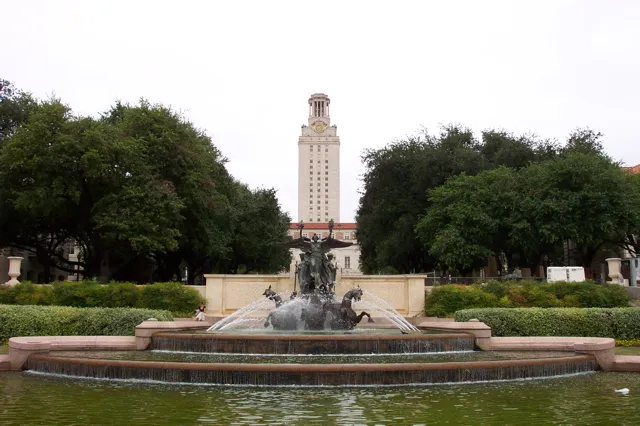
Picture of a statue at the University of Texas at Austin campus

Molly on the Shore

Irish Reel set for Military Band

Percy Grainger

Percy Grainger (1882-1961) was a piano prodigy born in Australia. He came to the United States at the outbreak of World War I, enlisted as an Army bandsman, and became an American citizen in 1918. His many masterworks for winds include “Lincolnshire Posy,” “Irish Tune from County Derry,” “Children’s March” and “Molly on the Shore.”

In “Molly on the Shore,” Grainger ingeniously combines two Cork reels, “Molly On The Shore” and “Temple Hill,” in a setting which features Grainger's most brilliant writing for winds. Grainger originally wrote “Molly on the Shore” in a 1907 as birthday gift for his mother. The wind band setting is but one of many, and it appeared in 1920.

Sea Chanteys

Bill Hoehne

1. Salts and Sails
2. Buccaneers' Regatta

Bill Hoene is the Director of Instrumental Music at Citrus College in Glendora, California, and directs the Sierra Wind Symphony of Citrus College.

“Sea Chanteys” is a soulful and sophisticated, but still fun and accessible, work for wind band. Presenting extreme contrasts of orchestration, texture, and color, this romantic tone poem evokes moments at sea through expressive solo lines, unique percussion contributions, harmonic effects, and engaging rhythms. The first movement, Salts and Sails, is a sentimental reflection of the spirited life often conveyed in songs of the sea. We hear the gentle sigh of the surf, feel the rolling, swelling surge of the waves, and imagine the billowing sails of great ships in passage. In movement two, Buccaneers' Regatta, we are launched into an ancient mariner's race between his heroic shipmates and a nefarious ship commandeered by vile scoundrels. While waves crash and cannons fire, ships' riggings whip in the rushing wind, and flocks of sea birds circle over the decks. Grand adventure on the high seas! “Sea Chanteys” was a finalist in the 2nd International Frank Ticheli Composition Contest in 2009.

Fontane di Rome (Fountains of Rome)

Poema Sinfonico per Orchestra

Ottorino Respighi
arr. Yoshihiro Kimura
  1. The Fountain of Valle Giulia at Dawn (La fontana di Valle Giulia all'Alba)
  2. The Triton Fountain in the Morning (La fontana del Tritone al mattino)
  3. The Trevi Fountain at Noon (La fontana di Trevi al meriggio)
  4. The Villa Medici Fountain at Sunset (La fontana di Villa Medici al tramonto)

Italian composer Ottorino Respighi (1879-1936) wrote several operas, ballet music, chamber music, piano and organ works as well as cantatas. His style was much influenced by the French Impressionists mixed with his unique personal flair. Japanese arranger Yoshihiro Kimura adapted Respighi’s symphonic poem “Fontane di Roma” for concert band.

“Fountains of Rome” is the first of Respighi’s “Roman trilogy” of symphonic poems. “Fountains of Rome” is followed by “Pines of Rome” and “Roman Festivals.” Each of the movements in “Fountains of Rome” depicts one of Rome’s iconic fountains at a different time of the day.

Water Fanfare

Joseph T. Spaniola

Original version commissioned by the Oklahoma State University Trombone Octet

During his time as artist-in-residence at Oklahoma State University in 2014, Dr. Joseph T. Spaniola collaborated with OSU faculty and performing ensembles to create new musical compositions. He rehearsed with university musicians and presented lectures and concerts which contained new and existing Spaniola works. The collaboration yielded several musical works.

One of these works, “Water Fanfare” is a fast-moving, energetic concert fanfare with interesting lines and continuous forward motion. “Water Fanfare,” originally written for trombone octet, premiered on May 28, 2008 at the International Trombone Festival in Salt Lake City by the Oklahoma State University Trombone Octet. The trombone octet commissioned the piece in honor of their winning the Emory Remington Trombone Choir Competition.

Dancing on Water

Frank Ticheli

Dr. Frank Ticheli is an American composer of concert band and other ensemble works. Ticheli has received numerous awards, and many of his most notable works are standards in concert band repertoire.

“Dancing on Water” is a joyous tribute to Ticheli’s longtime friend and colleague, Richard Floyd, and is partly inspired by Floyd’s love of sailing. In Ticheli’s own words:

“The work begins as an exuberant dance expressing feelings of unabashed joy. Imagine images of the sea on a perfect morning. This dance gives way to a heartfelt song played broadly in the horns and euphonium, supported by a playful background of crisp 8th-notes derived from the opening dance.

This ’song and dance‘ might have been sufficient as the work's material, but in the very center of the work appears something new—a kind of oasis, perhaps an island—a soulful interlude marked by mysterious solos and duos in the alto saxophone and clarinets. Then the work proceeds in reverse, suggesting an arch form, a return home by the same pathways, but with one final surprise: a massively full-throated coda, signaled by the horns, lifts the exuberance and majesty to new heights, driving this water journey to a powerfully exalted finish.”

In Storm and Sunshine

J. C. Heed

John Clifford Heed (1862-1908), known as the "March Wizard," published more than 60 marches. He was born in Hackesttstown, New Jersey, and by age 17 had mastered composition with harmony and counterpoint, and led the Hackettstown Cornet Band.

The story entitled "Hackettstown's Early Musicians" in the book The Story of Hackettstown New Jersey from 1754 to 1955 by J. Harold Nunn claims that it was Heed who actually wrote the march "The Stars and Stripes Forever" for John Philip Sousa.

“In Storm and Sunshine” was one of Heed's earliest works, and it remains his most popular. It has all the ingredients for a great march, and is often categorized as a circus march because of its bright tempo and dynamic range.

The Klaxon

Henry Fillmore

Henry Fillmore (1881-1956) was one of the great American march composers. If not as popular as his contemporary March King, John Philip Sousa, he was extraordinarily prolific, with more than 250 original works and more than 750 arrangements to his credit. Many of Fillmore’s pieces were originally published under pseudonyms.

A klaxon is a loud electric horn, typically used as a warning device. “The Klaxon” march, composed in 1929, was written for the Cincinnati Automobile Show, with the title referencing a car horn. At a breakneck speed and with sudden dynamic shifts, this march can be quite breathtaking.